
Zelve Open Air Museum (Overview)
Updated: Jun 12, 2020
Zelve is an open valley with a large cave settlement. The small area has fifteen Byzantine-era cave churches and remained a Turkish village until 1960. Today, Zelve is an open-air museum open to the public.
Visiting Information
The Zelve Open Air Museum is located 5 kilometers south of Avanos, here on Google Maps. You drive straight up to the entrance gate, which has a small gift shop and several cafés. Entrance is 20TL/person (in 2020), and free with a MüzeKart. Zelve is just 1 kilometer east of the Paşabağı Open Air Museum, whose famous fairy-chimney hermitages are also worth a visit.

Zelve makes for a great destination. Nice walking paths lead you to the main churches. The 2-kilometer walk through the Y-shaped valley offers chances to explore various cave rooms and to enjoy Cappadocia’s stunning terrain. Picturesque cones and enchanting caves line the two ravines. The fallen rock provides a cross-section view of the rooms.
Compared to the Göreme Open Air Museum, the Zelve churches are not well-preserved, so far fewer people visit. This means it can be far more pleasant. If you visit in the morning, you might enjoy the park all alone. Spring is the best time to visit, as the flowers are in bloom and birds soar above.
Byzantine History
Zelve was a Byzantine-era settlement. The oldest churches date to the 500s. Cappadocia has only a few such sixth-century churches, but half of them are concentrated at Zelve. We have no documents or external history about Zelve, so the architectural style is our only clue for dating.
Most likely, Zelve was a small troglodyte village in Greco-Roman times, and was then Christianized by Greek-speaking Romans in the fourth and fifth centuries. The area’s Roman/Byzantine name is unknown.
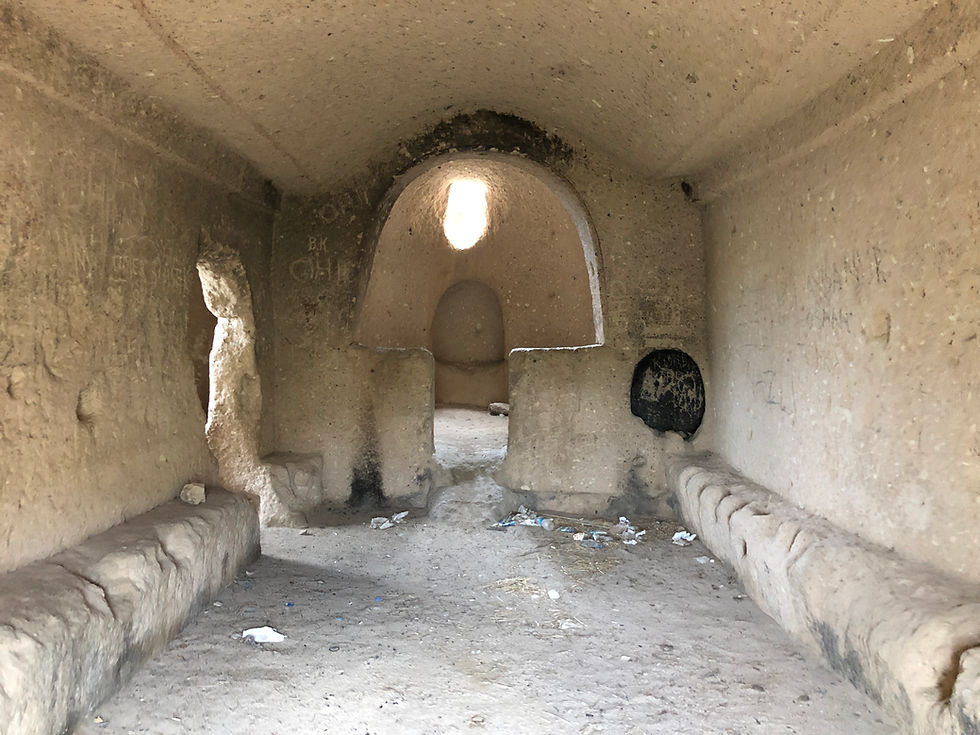
The function and nature of the Byzantine community are hard to determine. Throughout the site’s long history, many rooms have been repurposed, and many areas have collapsed. Besides the churches, there is a noticeable lack of form spaces. The area has no courtyard residences or large halls, and so has no sign of an elite social class. There are no remaining refectories or monks’ cells to suggest a monastic function. Most rooms were carved without any planning or architectural elements; they are plain and functional. The many dovecotes and winepresses suggest that Zelve was a simple agricultural village. For sustenance, people cultivated the fields at the valley opening.
After the Byzantine era, Zelve became a Turkish village in the Ottoman empire. The community inherited and expanded the carved spaces. The Turks even built a rare rock-cut mosque and centralized cemetery. They converted some of the churches into agricultural spaces, but left most of them untouched.
Modern History
In 1951-2, the families of Zelve resettled in Aktepe, a newly built village 1 kilometer to the northeast. The falling rock and collapsing rooms became too dangerous for human living. The breaking point occurred when rock collapsed onto visiting guests, killing an eleven-year-old girl. At that point, village leaders decided to relocate the residents and built traditional homes, for which the Turkish government provided assistance.

In the 1960s, Zelve became an official open-air museum and a UNESCO World Heritage site. To enhance Zelve’s allure and draw more tourists, the official narrative of Zelve became exoticized—this was an ancient monastic community with monks crawling through cave holes.
The official museum does not narrate the Turkish history of Zelve, which lasted some eight hundred years. Such traditional lifestyles have no place in Turkey’s new national identity, defined by progress and development. According to the new narrative, Turks are modern and civilized, not cave-dwellers. Ironically, visitors walk blindly through this “forgotten” Turkish history to enter the official museum. The cafés and shops just outside the museum are operated by Zelve’s past residents and their families. Now, they make a living by offering basic services—i.e., fresh juice, a public toilet, touristy trinkets—to foreign tourists who are visiting this historical museum, which is their former home. For more about this modern history, see “Tourism and the Loss of Memory in Zelve, Cappadocia.”
The Churches
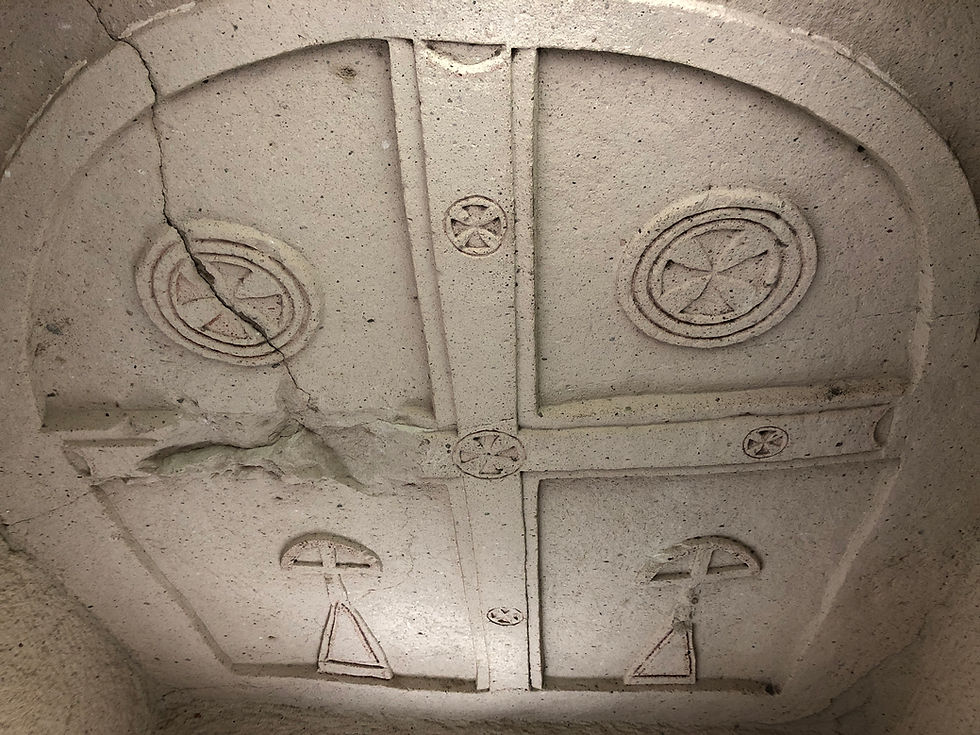
Zelve has fifteen Byzantine-era cave churches, though half are in poor condition. The several sixth-century churches are notable for the rock-relief decorations carved into the side walls. However, most of the Zelve churches date to the ninth and tenth centuries—the period when most Cappadocian churches were built. None of the churches dates to after AD 1100. Therefore, there is no (architectural) indication that Byzantine Christians and Ottoman Muslims lived together in the village.
Several features characterize the churches at Zelve. Compared to other Cappadocian churches, the churches at Zelve, in general, have:
fewer graves, so they were not funerary chapels,
split naves, which each segment decorated differently,
few multi-color icons painted on plaster; rather, they are decorated mostly with rock-cut and ochre-painted crosses, and
an early, often sixth-century, date.

The numbering system for the churches is unclear. The first researcher (i.e., Jerphanion in the early 1900s) found and identified six churches, and so named them “Zelve Church No. 1,” “Zelve Church No. 2,” etc. Subsequent researchers have found more churches, and so have named them 1a, 5a, 5b, 5c, etc., based on their proximity to the named churches. Two churches on the road to Avanos were named 7a and 7b. Here is a quick description of the churches. The main churches have separate posts.
Church 1, a single-nave chapel with many relief crosses, is halfway to Paşabağı.
Church 2 (Holy Cross Church), a large 6C hall with a side funerary chapel, is up the east ravine.
Church 3 has collapsed, but was part of the cone in the middle of the park.
Church 4 (Grape/Fish Church), a large double-aisle 6C basilica church, is east of the gate.
Church 4b, a finely-carved cruciform chapel, is on the ridge above Church 4.
Church 5 (a and b), two destroyed churches, lie at the head of the east ravine, above the so-called “Column Church,” which is actually a Seljuk/Ottoman-era animal stable.
Church 6, a single-nave church with carvings, is outside the park behind the stands.
Church 7 (a and b), single-nave churches with unique shapes, lie on the road toward Avanos.

UU888 làm mình để ý đến cách phần hỗ trợ được bố trí khi nhu cầu xuất hiện trong lúc sử dụng Thể thao. Mình chuyển sang khu vực liên hệ và quan sát cách các lựa chọn trao đổi được tập trung tách khỏi nội dung trước đó. Sự khác biệt về bố cục giúp mình nhận biết rõ lúc đã chuyển sang một chức năng khác. Sau khi xử lý phần cần thiết, mình chọn Bắn cá từ menu chung để tiếp tục phiên mà không cần quay lại đúng điểm ban đầu. Việc hỗ trợ có nhánh riêng nhưng vẫn nằm trong hệ thống điều hướng giúp mình chuyển giữa hai mục đích mà đường đi vẫn khá…
98WIN.COM giúp mình đánh giá cách những khu quen được thể hiện khi chuyển từ máy tính sang điện thoại. Mình thường quan sát thể thao, xổ số và casino trên cả hai thiết bị, chủ yếu xem menu cùng các danh mục chính có còn dễ xác định hay không. Trên màn hình nhỏ, mình vẫn bắt đầu từ khu lớn rồi mới đi sâu vào phần cần tìm như cách đã dùng trên máy tính. Sau vài lần chuyển đổi, mình dần quen với việc dựa vào cùng một trình tự thay vì nhớ riêng từng bố cục. Cách hiển thị có thể thay đổi theo màn hình, nhưng hướng tìm nội dung của mình vẫn giữ được logic…
1gom 7m thường được tôi mở khi muốn kiểm tra kết quả của nhiều trận vừa kết thúc trong cùng một khoảng thời gian. Tôi chọn ngày trước, sau đó xem tỷ số và trạng thái chính thức rồi mới mở thêm những thông số như kiểm soát bóng hoặc thẻ phạt nếu cần. Nếu dữ liệu trận có thể dẫn tiếp sang bảng xếp hạng của đúng giải, việc đối chiếu sẽ liền mạch hơn. Tôi cũng chú ý trận chưa hoàn tất có được phân biệt rõ với kết quả cuối hay không. Với tôi, khu kết quả dễ sử dụng khi thông tin được nhóm hợp lý, trạng thái rõ ràng và người dùng có thể quay lại…
Nbet link làm mình quan tâm đến khả năng thích nghi của giao diện khi cùng một nội dung được xem trên thiết bị khác nhau. Mình thử Thể thao trên máy tính rồi chuyển sang điện thoại để đối chiếu cách tiêu đề, hình ảnh và menu được bố trí. Khi không gian thu hẹp, các phần được sắp xếp lại nhưng những dấu hiệu chính vẫn giúp mình nhận ra khu vực đang sử dụng. Mình cũng thử cuộn sâu rồi tìm lại hướng chuyển trang từ vị trí đó. Cách giữ logic nhận diện giữa hai màn hình giúp mình tiếp tục trải nghiệm mà không phải làm quen với một cấu trúc hoàn toàn mới.
https://qq88gg.net/ với Bắn cá làm mình để ý đến khả năng tìm lại một khu vực sau khi đã chuyển sang mục đích khác trong cùng lần sử dụng. Mình ghi nhớ hình ảnh và vị trí ban đầu rồi sang phần khuyến mãi để quan sát cách các cụm ưu đãi được sắp xếp. Sau khi xem phần cần thiết, mình không lần ngược từng bước mà dựa vào menu để xác định nội dung trước đó. Điều mình muốn xem là những dấu hiệu ban đầu có còn đủ rõ để hỗ trợ việc quay lại hay không. Khi từng phần giữ được cách nhận diện riêng, mình có thể thay đổi phạm vi mà hướng sử dụng vẫn…